History of the franchise · 1853–2026
A vote
for every adult, from 1994.
For most of 140 years the right to vote in South Africa was rationed: by property, then by race. The Cape's franchise of 1853 made no mention of race; by the 1970s no black South African could vote for Parliament. On 27 April 1994 every adult citizen could, and the Constitution of 1996 made “universal adult suffrage, a national common voters roll, regular elections and a multi-party system of democratic government” a founding value (s.1(d)).
Timeline · 28 moments in five eras
Who could vote,
and who decided.
1853–1909
Colonial franchises
The Cape and later Natal set property qualifications blind to race in law but narrowed in practice; the Boer republics admitted only white men.
-
· Franchise
Cape Colony: a qualified, non-racial franchise
The Cape constitution (Order in Council of 1853) gave the vote for the new parliament to men owning property worth £25 or earning £50 a year, without regard to race. The first parliament met in 1854.
SecondaryWikipedia — the Cape qualified franchise (secondary) ↗
-
· Franchise
Cape: communal land no longer qualifies
The Parliamentary Voters' Registration Act excluded communally held land from the property qualification, removing many African voters in the Eastern Cape; the Franchise and Ballot Act of 1892 raised the qualification to £75 and added a literacy test.
SecondaryWikipedia — the Cape qualified franchise (secondary) ↗
1910–1947
Union: a white parliament
Only white men could sit in Parliament. White women were enfranchised in 1930 and white men freed of qualifications in 1931, while African voters in the Cape were moved off the common roll in 1936.
-
· Constitution
Union of South Africa
The South Africa Act 1909 united the four colonies. The Cape's franchise was kept, entrenched behind a two-thirds vote of both houses sitting together, but only white men could be elected to Parliament; elsewhere the franchise stayed white.
SecondaryWikipedia — Union of South Africa 1910 (secondary) ↗
-
· Franchise
White women get the vote
The Women's Enfranchisement Act 18 of 1930 gave the vote to white women only, doubling the white electorate and diluting the weight of the Cape's black voters.
SecondaryWikipedia — Women's Enfranchisement Act 1930 (secondary) ↗
-
· Franchise
Qualifications dropped — for white men
The Franchise Laws Amendment Act 41 of 1931 removed the property and literacy qualifications for white men in the Cape and Natal, but not for black and Coloured voters.
SecondaryWikipedia — the Cape qualified franchise (secondary) ↗
-
· Franchise
Cape African voters removed from the common roll
The Representation of Natives Act 12 of 1936, passed by the required two-thirds, put the Cape's African voters on a separate roll electing three white members of the House of Assembly.
SecondaryWikipedia — Representation of Natives Act 1936 (secondary) ↗
1948–1989
Apartheid
The National Party removed Coloured voters from the common roll, abolished the last separate representation, created 'homeland' citizenship and, in 1983, a tricameral Parliament that excluded the African majority.
-
· Election
The National Party wins
A white electorate returns D. F. Malan's Herenigde Nasionale Party with its ally the Afrikaner Party; apartheid becomes state policy.
-
· Franchise
Coloured voters removed from the common roll
After the courts struck down the Separate Representation of Voters Act 46 of 1951 (Harris v Minister of the Interior, 1952), the government enlarged the Senate and passed the South Africa Act Amendment Act 9 of 1956 by the two-thirds the entrenched clause required; Collins v Minister of the Interior (1957) upheld it.
SecondaryWikipedia — Separate Representation of Voters Act (secondary) ↗
-
· Franchise
African representation abolished
The Promotion of Bantu Self-Government Act 46 of 1959 ended the 1936 Natives' Representatives (from 1960), assigning Africans to 'homelands'; Coloured representatives were abolished in 1968 (Separate Representation of Voters Amendment Act 50 of 1968).
SecondaryWikipedia — Promotion of Bantu Self-Government Act (secondary) ↗
-
· Constitution
Republic
After a whites-only referendum (5 October 1960), South Africa becomes a republic and leaves the Commonwealth.
-
· Constitution
Tricameral Parliament approved
White voters approve the Republic of South Africa Constitution Act 110 of 1983: separate houses for white, Coloured and Indian voters, none for Africans. The United Democratic Front forms to oppose it; the Coloured and Indian houses are elected in August 1984 on very low turnouts.
SecondaryWikipedia — the Tricameral Parliament (secondary) ↗
1990–1996
Negotiated transition
Unbannings and the release of Nelson Mandela, the CODESA and Multi-Party Negotiating Process talks, the interim Constitution and the first election on a universal franchise on 27 April 1994.
-
· Government
Unbanning
F. W. de Klerk lifts the bans on the ANC, PAC and SACP; Nelson Mandela is released on 11 February 1990.
-
· Constitution
CODESA
The Convention for a Democratic South Africa opens at Kempton Park; talks collapse in 1992 and resume as the Multi-Party Negotiating Process in 1993.
SecondaryWikipedia — CODESA (secondary) ↗
-
· Election
Last whites-only referendum
68,7% of white voters back continuing the negotiations.
-
· Constitution
Interim Constitution
The Constitution of the Republic of South Africa Act 200 of 1993, with 34 constitutional principles binding the final text, a Government of National Unity for five years, and an Independent Electoral Commission (Act 150 of 1993).
OfficialConstitution of the Republic of South Africa Act 200 of 1993 (gov.za) ↗
-
· Franchise
Universal franchise: the first democratic election
Polling ran 26–29 April, 27 April the main day, with no voters' roll: any adult citizen with an identity document could vote. The ANC won 62,65% and 252 of 400 seats; Nelson Mandela was inaugurated President on 10 May. 27 April is Freedom Day.
OfficialElectoral Commission (IEC) ↗
-
· Judgment
The Constitution is certified
The Constitutional Assembly adopted the text on 8 May 1996; the Constitutional Court refused to certify it (6 September 1996), certified the amended text (4 December 1996), and Mandela signed it at Sharpeville on 10 December. In force 4 February 1997.
CourtCertification of the Amended Text of the Constitution [1996] ZACC 24 ↗
1997–today
Constitutional democracy
The 1996 Constitution, ANC majorities from 1994 to 2019, courts that extended the vote to prisoners and citizens abroad and opened elections to independent candidates, and from 2024 a coalition Government of National Unity.
-
· Judgment
Prisoners may vote
August v Electoral Commission: the right to vote cannot be removed without a law; the IEC must let prisoners register. In NICRO (2004) the Court struck down the law that then barred prisoners serving sentences without the option of a fine.
-
· Election
The first municipal elections under the new system
After the transitional local elections of 1995–96, the Municipal Structures Act 117 of 1998 created metropolitan, district and local municipalities with ward and PR councillors.
OfficialElectoral Commission (IEC) ↗
-
· Law
Floor-crossing
The Constitution Tenth Amendment Act of 2003 let MPs and provincial members change party without losing their seats in window periods (2003, 2005, 2007); councillors could from 2002. It was abolished by the Constitution Fourteenth and Fifteenth Amendment Acts of 2008, from 2009.
OfficialConstitution of the Republic of South Africa, 1996 (gov.za) ↗
-
· Government
Mbeki recalled
The ANC recalls Thabo Mbeki; Kgalema Motlanthe is elected President by the Assembly until the 2009 election.
-
· Judgment
Citizens abroad may vote
Richter v Minister for Home Affairs: registered voters abroad may cast special votes in national elections.
-
· Government
Zuma resigns
Jacob Zuma resigns under pressure from the ANC; Cyril Ramaphosa is elected President by the Assembly on 15 February 2018.
-
· Judgment
Independent candidates
New Nation Movement v President: the Electoral Act is unconstitutional because adult citizens can stand for the National Assembly and provincial legislatures only through parties; Parliament was given 24 months (later extended) to fix it.
-
· Law
Electoral Amendment Act
The Electoral Amendment Act 1 of 2023 lets independent candidates stand in nine regions: the Assembly's 400 seats become 200 regional and 200 compensatory, with three ballots. In December 2023 the Constitutional Court upheld the split but cut the signature requirement for independents to 1 000.
OfficialSAnews — President Ramaphosa signs Electoral Amendment Bill into law ↗
-
· Judgment
Zuma barred from standing
Electoral Commission v MK Party: a person sentenced to more than 12 months' imprisonment may not stand for the Assembly for five years after the sentence (s.47(1)(e)), so Jacob Zuma could not be a candidate, though his face stayed on the MK Party's ballot line.
CourtElectoral Commission v Umkhonto weSizwe Political Party [2024] ZACC 6 ↗
-
· Election
The ANC loses its majority
The ANC falls to 40,18% and 159 seats; the DA wins 87, the new MK Party 58. Ten parties form a Government of National Unity; the Assembly re-elects Ramaphosa on 14 June 2024.
OfficialElectoral Commission (IEC) ↗
-
· Election
Local government elections
Councils for 257 municipalities and 4 488 wards; special votes on 2 and 3 November.
OfficialIEC election timetable, General Notice 4086 of 2026 (Government Gazette 55163) ↗
National Assembly · seven elections · IEC
Thirty years of the ANC,
and the end of its majority.
Share of the national ballot by party, 1994–2024. The ANC rose to 69,7% in 2004 and fell below half for the first time in 2024, to 40,2%. Parties that never reached 3% are grouped as “others”.
- ANC · African National Congress
- NP · National Party
- IFP · Inkatha Freedom Party
- DP · Democratic Party
- NNP · New National Party
- UDM · United Democratic Movement
- DA · Democratic Alliance
- COPE · Congress of the People
- EFF · Economic Freedom Fighters
- MK · uMkhonto weSizwe Party
- Others
Line: the ANC's share. Dashed line: 50%. Since 2024 the national ballot is the compensatory ballot; seats are shared over the national and regional ballots together (seat lab →). 2004: the IEC's seat report assigned 399 of 400 seats.
| Party | 1994 | 1999 | 2004 | 2009 | 2014 | 2019 | 2024 |
|---|---|---|---|---|---|---|---|
| ANC | 252 | 266 | 279 | 264 | 249 | 230 | 159 |
| NP | 82 | – | – | – | – | – | – |
| IFP | 43 | 34 | 28 | 18 | 10 | 14 | 17 |
| DP | 7 | 38 | – | – | – | – | – |
| NNP | – | 28 | 7 | – | – | – | – |
| UDM | – | 14 | 9 | 4 | 4 | 2 | 3 |
| DA | – | – | 50 | 67 | 89 | 84 | 87 |
| COPE | – | – | – | 30 | 3 | 2 | 0 |
| EFF | – | – | – | – | 25 | 44 | 39 |
| MK | – | – | – | – | – | – | 58 |
Seats in the National Assembly (of 400). NP: National Party; NNP: New National Party (1997–2005); DP: Democratic Party, which formed the DA in 2000.
Turnout · registered voters and votes cast
The roll grew,
the queues shortened.
1994 had no voters' roll: any citizen with an identity document could vote, and 19 533 498 valid votes were counted. From 1999 voters had to register. The roll has grown from 18 162 063 to 27 782 081; votes cast peaked at 18 654 771 in 2014 and fell back to 16 291 516 in 2024.
Presidents since 1994 · elected by the National Assembly
Five presidents,
one party.
-
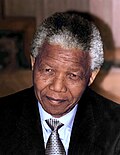 Nelson Mandela 10 May 1994 – 14 June 1999
Elected by the Assembly on 9 May 1994 under the interim Constitution; served one term.
-
 Thabo Mbeki 14 June 1999 – 24 September 2008
Elected 1999 and 2004; resigned after the ANC recalled him.
-
 Kgalema Motlanthe 25 September 2008 – 9 May 2009
Elected by the Assembly to fill the vacancy.
-
 Jacob Zuma 9 May 2009 – 14 February 2018
Elected 2009 and 2014; resigned. From December 2023 the face of the MK Party.
-
 Cyril Ramaphosa 15 February 2018 – in office
Elected to fill the vacancy in 2018, then in 2019 and on 14 June 2024 at the head of the GNU.
Photos: Nelson Mandela — Kingkongphoto & www.celebrity-photos.com, CC BY-SA 2.0 · Thabo Mbeki — Antônio Milena/ABr, Attribution (Agência Brasil) · Jacob Zuma — Presidential Press and Information Office / Пресс-служба Президента России, CC BY 4.0 · Cyril Ramaphosa — Ricardo Stuckert, CC BY 4.0 . Others public domain. Via Wikimedia Commons.
Mandela was elected under the interim Constitution, which also made F. W. de Klerk and Thabo Mbeki executive deputy presidents in the first Government of National Unity (1994–96). Dates: history.ts; Motlanthe's and Ramaphosa's accession dates from Wikipedia (secondary).
Municipal elections · 1995–2026
Seven rounds of
local elections.
| Year | Polling day | ANC | DA | Turnout | Note |
|---|---|---|---|---|---|
| 1995–96 | 1 November 1995 | – | – | – | Transitional councils under the Local Government Transition Act 209 of 1993; the Western Cape and KwaZulu-Natal voted in 1996. Wikipedia (secondary) |
| 2000 | 5 December 2000 | 59,4% | 22,1% | 48,1% | First elections under the Municipal Structures Act: metros, districts and locals with ward and PR councillors; the DA's first election. Wikipedia (secondary) |
| 2006 | 1 March 2006 | 64,8% | 16,2% | 47,9% | Wikipedia (secondary) |
| 2011 | 18 May 2011 | 62,0% | 23,9% | 57,6% | Wikipedia (secondary) |
| 2016 | 3 August 2016 | 53,9% | 27,4% | 57,9% | The ANC loses its majorities in Johannesburg, Tshwane and Nelson Mandela Bay; coalition and minority governments follow. Wikipedia (secondary) |
| 2021 | 1 November 2021 | 45,6% | 21,7% | 45,8% | The ANC falls below 50% nationally for the first time; 70 hung councils. IEC |
| 2026 | 4 November 2026 | 31,7% | 24,9% | – | Provisional: 16 251 of 23 696 voting districts counted when the snapshot was taken (6 November 2026). Live results → IEC |
Shares: 2000–2016 as Wikipedia's election articles give them (secondary; the measure — PR ballot or all ballots — is not the same in every year); 2021 and 2026 from the IEC results feed (all ballots). 2021 turnout: Wikipedia, citing the IEC. The 2026 turnout is not final.
Rule changes since 1994
The rules
after the transition.
- 1999
A voters' roll
The Electoral Act 73 of 1998 sets up the national common voters' roll: from 1999 citizens register, with a South African identity document, in the voting district where they live. The Constitutional Court upheld the identity-document requirement in New National Party v Government (1999), and in August v Electoral Commission (1999) held that prisoners could not be left off the roll without a law.
- 2002–2009
Floor-crossing
Councillors from 2002, and members of Parliament and the provincial legislatures under the Constitution Tenth Amendment Act of 2003, could change party without losing their seats in fixed windows (2003, 2005, 2007 for legislators). The Fourteenth and Fifteenth Amendment Acts of 2008 abolished it from 2009.
- 2009
Voting abroad
Richter v Minister for Home Affairs: registered voters outside the country may cast special votes in national elections.
- 2020–2023
Independent candidates
New Nation Movement v President (11 June 2020) held the Electoral Act unconstitutional because adults could stand for the Assembly and the provincial legislatures only through a party. The Electoral Amendment Act 1 of 2023 answered with three ballots and a House of 200 regional and 200 compensatory seats; the Constitutional Court upheld the split on 4 December 2023.
- 2024
First election under the new law
Independent candidates stood in the regions and provinces; none won a seat in the Assembly. The Constitutional Court ruled that Jacob Zuma, sentenced to 15 months in 2021, could not be a candidate (s.47(1)(e)).